
The delivery is complete and the customer price has not changed. The original estimate suggested a healthy result, yet much less remains after the trip. The vehicle took a detour, waited longer than expected and continued moving after the final delivery.
The useful question is not who to blame. It is which assumption changed, which cost was missing and what the team should do differently next time.
Good road transport cost control starts by comparing the original estimate with the journey that the vehicle actually completed.
Keep the original estimate
Do not overwrite the first calculation after the trip. Keep it as the baseline. It should show the expected revenue, route, starting position, planned finish and the costs included in the estimate.
Compare the completed trip using the same scope. If the estimate began where the vehicle was first available and ended after planned repositioning, the review must cover the same movement. Use the same cost categories and allocation method for driver time, vehicle cost and overhead.
Our guide to reviewing trip profitability before accepting a job explains how to build this starting estimate. The completed-trip review has a different purpose: finding out why the result changed.
Separate recorded facts from estimates
Start with facts that can be supported by the trip record and the company’s other documents. Check the actual route and timings, fuel information, toll and parking records, driver or time costs, and movements after delivery.
Keep estimates and missing documents clearly marked. A toll invoice that has not arrived should not disappear from the review. At the same time, a provisional amount should not be presented as a confirmed cost.
Compare each cost with the matching item in the original estimate. If you start from the planned total, add only the difference. Do not add a full fuel bill on top of a fuel allowance that is already included. Treat waiting and repositioning costs in the same way.
A short example of where the result changed
Consider this hypothetical company example. The amounts are illustrative, not market rates. A completed trip produced revenue of €1,400. The original estimate included costs of €1,000, leaving an estimated result of €400.
The post-trip review finds three extra costs that were not included in the first calculation:
- an additional €54 of fuel, using the company’s own fuel valuation;
- €36 of tolls and parking supported by company records;
- €50 of extra driver and time cost under this company’s costing method.
These amounts are not already included elsewhere, so adding them does not double-count the cost. Revised included costs are €1,140. The estimated result falls from €400 to €260, a reduction of €140.
The €260 is not confirmed net profit. It is the result within this company’s chosen model before any costs or taxes left outside the calculation.
Trace the difference to what actually happened
A higher fuel figure does not prove that the driver drove badly. The vehicle may have followed a diversion, idled while waiting, carried a different load or continued to another location after delivery. Review the route and timing with the driver before drawing a conclusion.
Fuel consumed is also different from fuel purchased. A vehicle may refuel during one trip and use some of that fuel later. The purchase belongs in the company’s financial records, but the litres bought should not automatically be treated as consumption for that trip.
Post-delivery consumption can be important, but it is not automatically empty running. Find out whether the vehicle moved to parking, a depot, another loading point or somewhere else. The reason for the movement determines what should change next time.
Waiting deserves the same care. Records may show that the trip took longer than planned, but charging the customer for waiting depends on the relevant evidence and agreement. The review should identify the cost without assuming it can be recovered.
Where Moveniq supports the review
The estimate prepared with the quote calculator gives the team a starting point. In Moveniq for carriers, the saved trip helps the dispatcher relate route and timing changes to the assigned vehicle and supporting documents.
Where adequate vehicle data and actual trip times are available, trip fuel analysis can show consumed litres, refuelled litres, average consumption and a separate post-delivery consumption figure when the last-delivery data allows it. Its quality label distinguishes measured consumption from an estimate based on tank-level balance and refuelling.
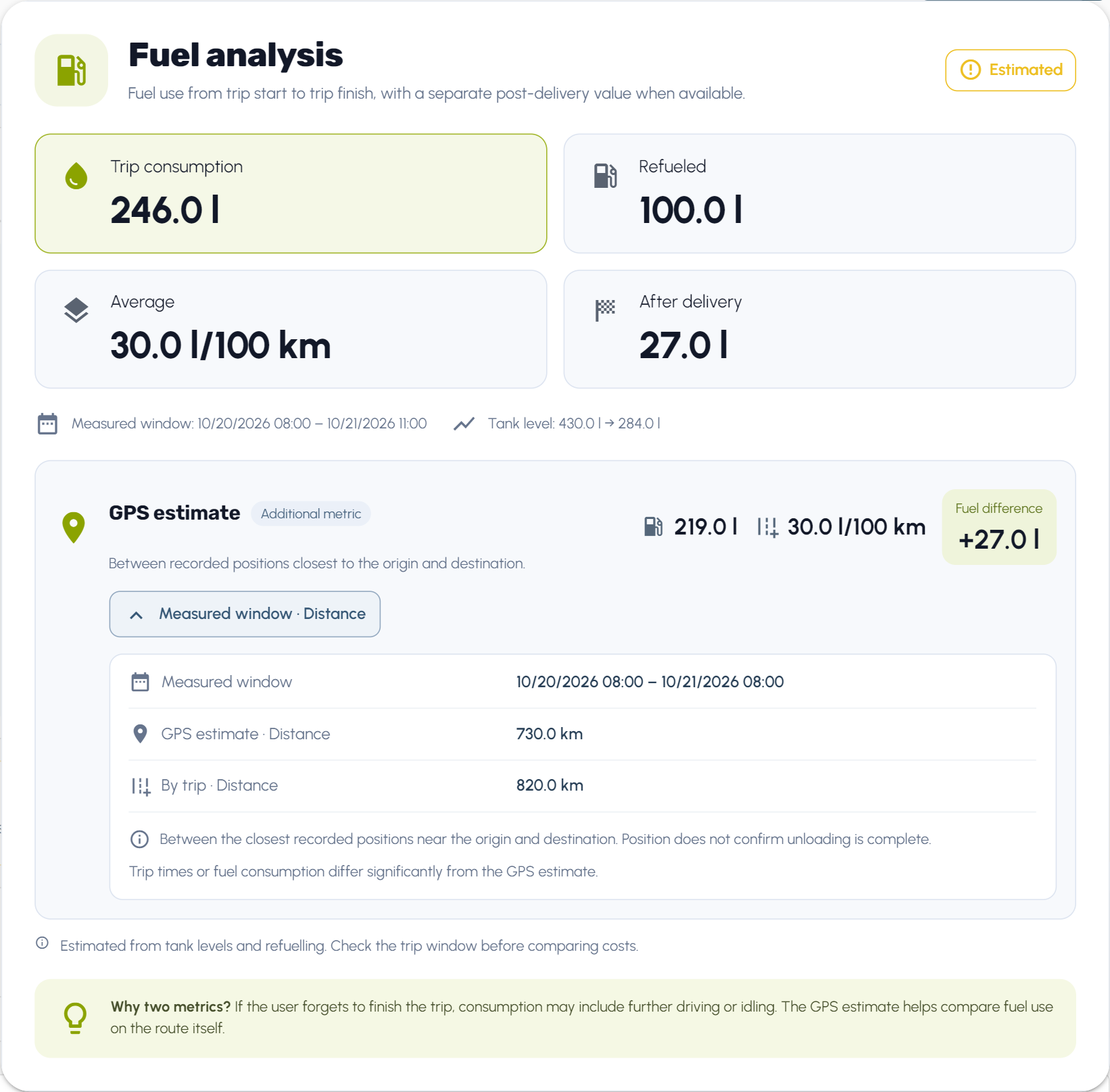
If actual trip times or suitable samples are missing, the analysis may remain pending or show insufficient data. Fuel-analysis litres are one part of the evidence, not a complete euro-cost or profit calculation. Driver and time costs, tolls, parking and allocated overhead still come from the carrier’s company records and costing method.
Turn one finding into a change
Do not respond to one weak result by increasing every rate or blaming the driver. First identify a cause that can be acted on. Perhaps the estimated route omitted a regular toll section, a customer site repeatedly adds waiting or the trip boundary ends before a necessary post-delivery movement.
Choose one owner and one change for the next similar trip. The transport manager might update the route assumption, the dispatcher might allow more time at a regular loading site, or the costing model might include a movement that was previously missed.
The next review should check whether that change improved the estimate. Cost control becomes useful when each completed trip leaves the team with a clearer assumption for the next one.