
Imagine a road haulage company that still uses its cost per kilometre from six months ago when preparing estimates. Since then, the rental cost of its truck and trailer has changed, and the vehicle is covering fewer kilometres. The figure in the estimate looks precise, but it no longer reflects the company's actual operating conditions.
It is therefore important not only to calculate your own cost per kilometre but also to understand what it includes and which kilometres the costs are spread across. The basic formula is simple:
Cost per kilometre = costs for the selected period ÷ total kilometres driven during the same period.
Which costs should you include in the calculation?
Start with one vehicle combination and a period for which you have both cost and mileage figures. If you operate a tractor unit with a semi-trailer, include the trailer's costs as well. Comparing a tractor unit alone with a complete vehicle combination would not give like-for-like results.
Fuel and road tolls are visible costs on every trip. However, the carrier also pays for the driver, the use of the truck and trailer, insurance, maintenance and tyres. An agreed share of the company's overheads, such as dispatching, administration or software, should also be allocated to the vehicle combination. Depending on the operation, additional expenses may include AdBlue, parking and ferries.
What matters is the costs attributable to the period, not just the invoices you paid during it. Spread annual insurance costs across the months they cover. For maintenance and tyres, using a longer period helps prevent a single major repair from determining the vehicle's typical operating cost. The amount of fuel consumed may also differ from the amount purchased during a particular month.
Count each cost item only once. If you own the vehicle, use your company's financial records to establish how you allocate its acquisition and financing costs. The full loan repayment and depreciation are not two independent cost items for the same vehicle.
Example: monthly costs of €12,000 and 10,000 kilometres driven
In our hypothetical example, a carrier operates one rented truck and trailer and employs a driver. The vehicle covers 10,000 km in a month. The following figures are invented to illustrate the calculation and do not represent market rates. All amounts exclude VAT.
| Cost item | Monthly allocation |
|---|---|
| Fuel consumed | €4,200 |
| Road tolls | €1,400 |
| Driver, including associated employer costs | €3,200 |
| Truck and trailer rental | €1,500 |
| Insurance and recurring fees | €400 |
| Maintenance and tyres – allocation for the period | €800 |
| Allocated company overheads | €500 |
| Total | €12,000 |
€12,000 ÷ 10,000 km = €1.20/km
Based on this breakdown, each kilometre driven costs an average of €1.20. The result includes the costs listed above. It does not include profit and is not the price charged to the customer for transport.
Total kilometres driven are not the same as kilometres billed to the customer
Of the 10,000 km in our example, 8,000 km were driven with a load and 2,000 km were empty journeys. We do not exclude empty kilometres. They are part of the total distance driven, and their costs are already included in the €12,000.
Now assume that this carrier bills its customers only for those 8,000 loaded kilometres. To recover all the monthly costs listed above through those kilometres, the calculation gives a different result:
€12,000 ÷ 8,000 billed km = €1.50 per billed km
The truck and trailer have not suddenly become more expensive to operate. The costs are still €12,000. The difference lies in how many kilometres we spread those costs across. The €1.20 figure represents the average cost across all kilometres driven, while €1.50 allocates the same costs across the kilometres billed in this example.
Not every company charges customers only for loaded kilometres. A customer may also pay for an empty journey or agree on a price for the entire transport job. For this reason, €1.50 is not a universal minimum rate. Even in our example, it only covers the costs listed above, without any profit.
When should you recalculate your cost per kilometre?
Update your calculation whenever fuel consumption, fuel prices, tolls, driver costs or vehicle costs change. The distance driven is equally important. During a quieter month, you may spend less on fuel and tolls, but you still have to pay for rental and insurance. Recurring costs are then spread across fewer kilometres.
Covering more kilometres can therefore reduce the average cost per kilometre, but it does not automatically increase profit. The price you receive for the work also matters. A practical approach is to update your cost breakdown every month and track the average over a longer period as well. This helps ensure that seasonal fluctuations or a single major repair are not hidden behind one figure.
Why the average is not enough when calculating an individual trip
Two journeys of 500 km each can occupy the vehicle and driver for very different lengths of time. One may run smoothly, while the other involves long waits at loading and unloading points. Fuel consumption, tolls and the empty distance required may also differ.
The average cost per kilometre does not capture these differences. For an individual transport job, consider the total distance, the driver's working time and how long the vehicle is occupied.
Treat the monthly average in our example as a reference point for estimating and checking costs. For an individual transport job, assess the route, the time required and the costs that will actually arise. We explain how to use this information when deciding whether to accept a job in our article on how to assess whether an individual trip is profitable.
How Moveniq helps calculate transport costs
Once you have calculated your own operating costs, the dispatcher has a starting point for preparing the next transport job. The Moveniq transport cost calculator allows the dispatcher to work with a specific route, fuel, tolls and driver costs. They can also add other items, such as an allocated share of truck and trailer rental, maintenance or overheads.
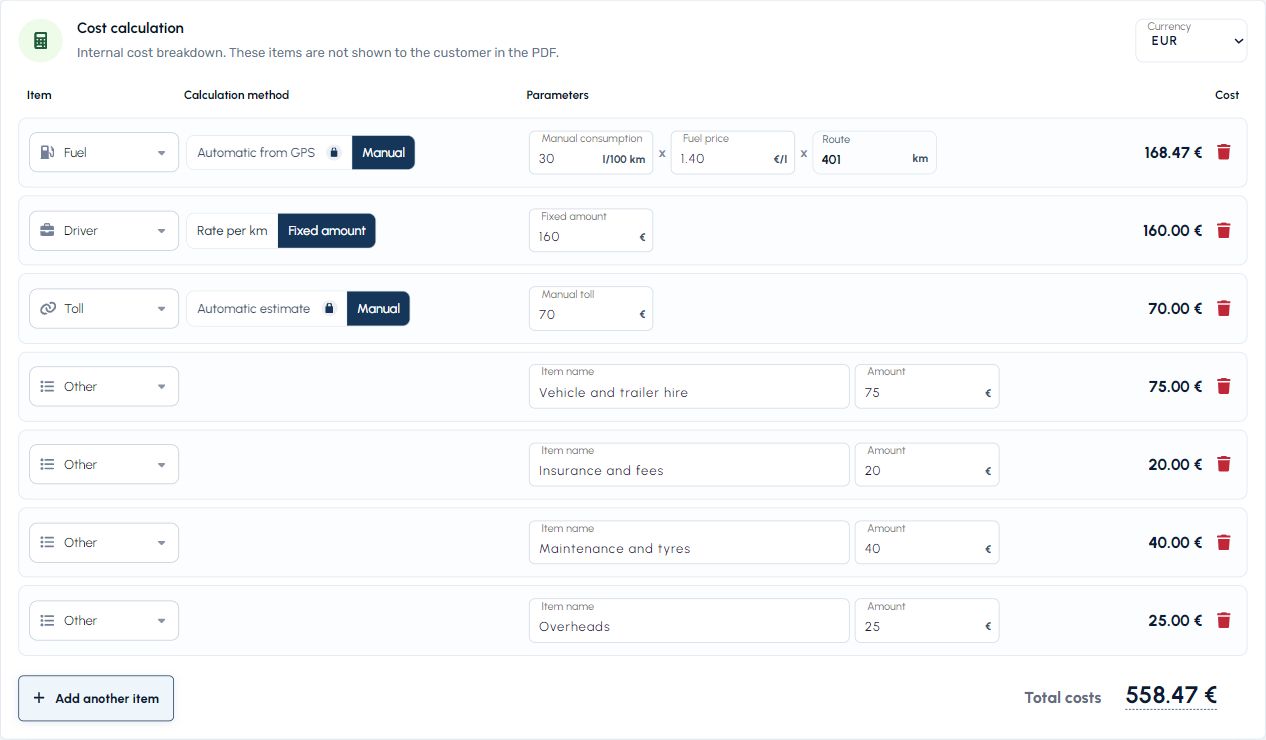
The breakdown and total of the entered items help the dispatcher check whether costs such as the vehicle or overheads have been overlooked. The estimate can then be compared with the price offered by the customer or used to prepare a quote.
The carrier calculates its monthly costs using its own records. When calculating an individual transport job, Moveniq uses the cost items you include. Checking the final total alone is therefore not enough: the dispatcher also needs to understand the route, time and costs behind it.