
A colleague is unexpectedly away from work. A customer calls to ask whether today’s collection is arranged. The covering forwarder opens the load and sees two carrier replies, but cannot tell whether either carrier accepted the revised collection time.
The team now has a familiar problem. Someone must call the absent colleague, repeat questions to the carriers or risk giving the customer an answer based on old information. A poor handover can lead to contradictory promises, duplicate enquiries and several people chasing the same answer.
Good freight team collaboration is not about giving everyone more messages to read. It is about making the current position and the next action clear enough for another colleague in the forwarding team to continue the work.
Start with the customer’s current requirement
Before contacting anyone, the covering forwarder needs to establish what the customer currently wants. The original request is not enough if the route, collection window or another important instruction has changed.
The working record should point to the latest customer instruction and make any unresolved detail visible. Relevant source documents and messages should remain easy for authorised colleagues to find. Sensible names also help. A record called “Brno–Lyon, collection 9 November” is easier to recognise than an unexplained reference number in a private spreadsheet.
Updating an internal record does not itself tell the customer or carrier about a change. The team still needs to know who received the revised instruction and whether they accepted it.
Read carrier replies in the right order
A carrier response only makes sense in the context of the request it answered. An older message may refer to the original collection time, while a newer reply may discuss a revised window.
Check who sent each message, when it was sent and which requirement it covered. Separate a confirmed fact from a possible solution. “Vehicle available” does not necessarily mean “revised collection window accepted”.
If the answer is incomplete, ask only the missing question. Repeating the whole enquiry wastes time and may create another version of the job. The open point should remain visible until the carrier provides a clear response.
A handover should explain what happens next
Consider this hypothetical example. Petra is away, so Martin takes over a Brno–Lyon road-freight load. The customer moved collection from 08:00 to 12:00–14:00.
One older carrier reply refers to collection at 08:00. The latest reply says that the vehicle is available, but it does not confirm the revised window. The carrier expects to provide an answer by 10:00.
Martin checks the latest customer instruction and the relevant carrier conversation. He does not tell the customer that the transport is confirmed. He asks the carrier only whether it accepts collection between 12:00 and 14:00, and keeps that point open while waiting for the reply.
A useful internal handover can be as short as four lines:
- Current requirement: Brno–Lyon, collection changed to 12:00–14:00.
- Confirmed and open: Vehicle available; revised collection window not yet confirmed.
- Next action: Martin checks with the carrier; answer expected by 10:00.
- Source: Latest customer instruction and the relevant carrier conversation.
This is an internal team practice, not a message intended for the external carrier conversation. Its purpose is to let a colleague understand the situation without reconstructing the whole story.
Decide who follows up
Every unfinished load needs one clear next action. Name the person responsible and the time by which they should check again. “Waiting for the carrier” is vague. “Martin will follow up at 10:00” tells the team what should happen.
This does not require a long checklist for every load. The handover only needs to answer five practical questions: What does the customer currently require? What have carriers actually said? What has been agreed? Which answer is missing? Who acts next, and when?
The simplest test is to ask a colleague who was not involved to explain what happens next. If they need to call the absent forwarder or search several private inboxes, the working record is still missing useful context.
Where Moveniq helps
In Moveniq for freight forwarders, colleagues with access within the same forwarding company can open carrier conversations linked to a load. They can see which load is being discussed, who replied and whether the latest response settles the open question.
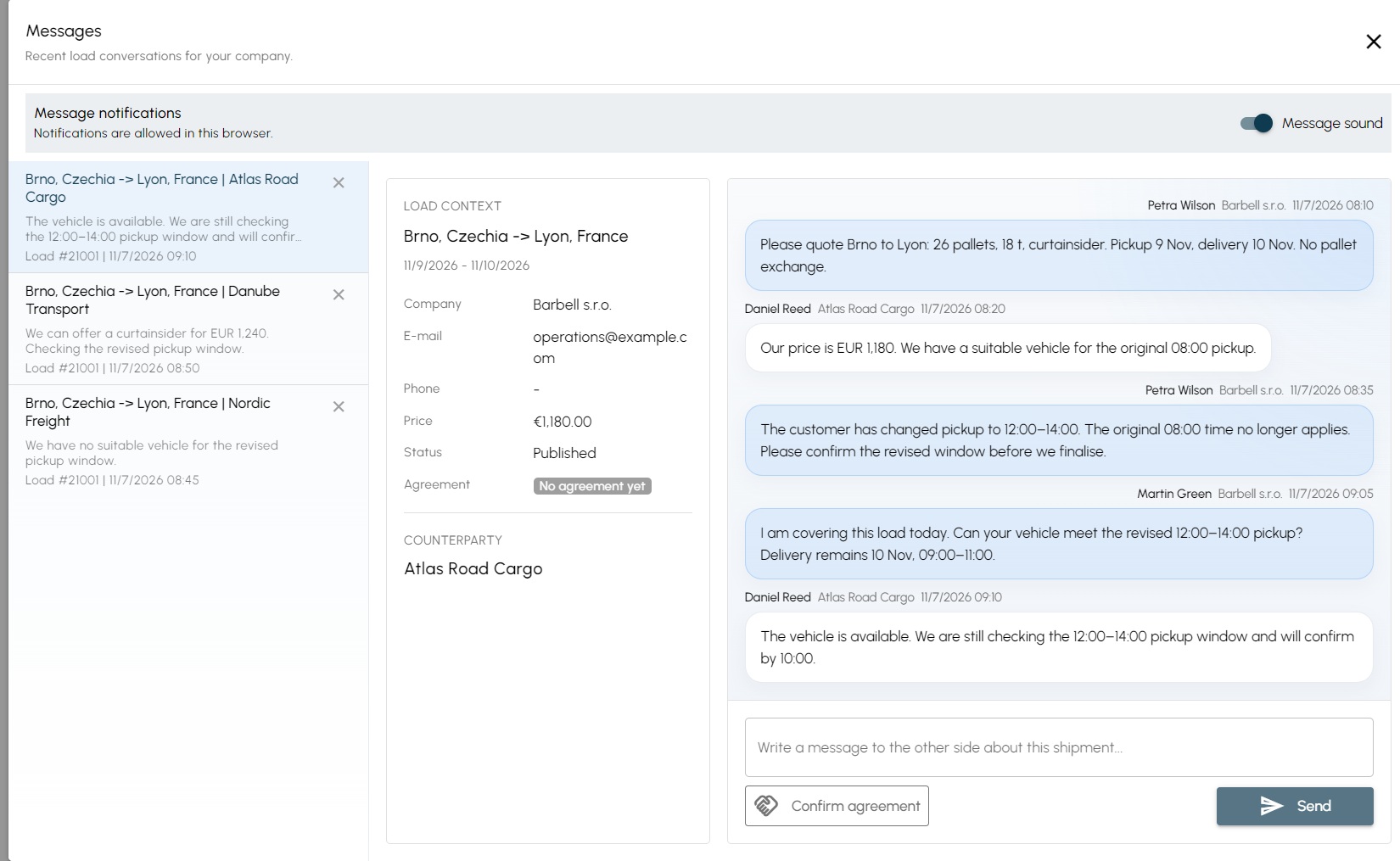
Relevant documents can stay attached to the load as well. This helps the covering colleague compare the latest carrier reply with the load they are handling instead of starting with an unexplained message.
Keep the internal handover summary in the team’s agreed internal place. Use the carrier conversation to clarify what is still missing from that carrier. The team still needs to record who follows up and when.
A good handover lets work continue
The goal is not to document every call in detail. It is to leave enough reliable context for another forwarder to continue without guessing or repeating completed work.
For the Brno–Lyon load, Martin should be able to see the revised 12:00–14:00 collection window, the carrier’s latest response, the missing confirmation and the expected answer by 10:00. Until that answer arrives, the revised collection time remains unconfirmed.
When a colleague can explain the current requirement and the next action after one review, the freight team handover is doing its job.