
A customer asks for a transport price for eight pallets from Brno to Milan next week. The request sounds simple, so the forwarder contacts several carriers.
One carrier assumes standard pallets that can be stacked. Another prices a heavier, non-stackable load. A third expects flexible loading during the day. Their prices may all be reasonable, but they do not describe the same transport.
If the forwarder gives the customer a price too early, the missing details can force another round of calls and revised offers. The risk is not only extra work. The forwarder may promise a price or timing that no suitable carrier has accepted.
Ask what could change the carrier’s answer
Good transport order intake does not mean asking every possible question for every job. It means identifying the unknowns that could change the required vehicle, the available capacity, the timing or the carrier’s price.
Weight and dimensions matter because eight pallets can occupy very different amounts of space and payload. Stackability matters because non-stackable pallets may use much more floor space. A loading site without suitable equipment may require a different vehicle or handling arrangement.
Timing can change the answer just as much. “Next week” does not tell a carrier whether collection is flexible across several days or fixed to a two-hour warehouse slot. A delivery appointment may also affect whether the proposed vehicle can complete the work.
The forwarder does not need to prove that the transport is feasible before contacting anyone. But if a detail that could materially affect feasibility or price is unknown, it should either be clarified with the customer or stated clearly as an assumption in a provisional request.
Keep customer requirements and carrier prices separate
The customer tells the forwarder what needs to be transported and may ask for a selling price. The carrier gives the forwarder a price for performing the transport under stated conditions. These are separate commercial figures.
A carrier’s quote is useful only when it covers the work the customer actually needs. If the customer has not confirmed the weight, the forwarder should not silently choose one. If the loading time is still flexible, the carrier should know that. Assumptions must not appear as confirmed instructions.
This also makes later comparison fairer. Two carrier prices can be compared properly only when both carriers received the same important conditions.
Ask one clear question instead of sending six messages
A concise bundled question is usually easier for the customer to answer than several separate messages:
“Please confirm the pallet dimensions and total weight, whether the pallets can be stacked, the required loading method, and the collection and delivery windows. We need these details to ask carriers for a price against the same conditions.”
Only include questions that matter to the job. A standard pallet movement between two warehouses may not need the same clarification as oversized freight, controlled-temperature goods or a site with restricted access.
If the customer cannot yet answer everything, agree what can follow later. Record who will provide it and by when. The carrier request should make clear which point remains open.
A complete brief can still have one open detail
Consider this hypothetical example. The first request says only: eight pallets from Brno to Milan next week. After one clarification, the forwarder establishes the following:
- eight pallets, each measuring 120 × 80 × 140 cm;
- total weight of 4,800 kg;
- the pallets cannot be stacked;
- rear loading, with a forklift available at both sites;
- a curtainsider is suitable;
- collection on 10 November from 08:00 to 10:00;
- delivery on 11 November from 09:00 to 11:00, local time.
These are example conditions, not a universal checklist, and they do not guarantee that the schedule is feasible. They give carriers a clearer description of the same job.
The customer still needs to provide the warehouse loading reference. Petra, the forwarder handling the enquiry, agrees to obtain it by 15:00 on 9 November. If the reference does not affect access or the booked slot, the forwarder can ask carriers to price the confirmed conditions while stating that the reference will follow before collection. The missing reference remains open until the customer supplies it.
Where Moveniq helps
In Moveniq for freight forwarders, the team can keep a shared load draft with the route, timings, cargo, vehicle requirements and relevant load information. This gives colleagues one checked working brief before they ask external carriers for prices.
If the customer provides a supported freight-offer document, optional AI import can prepare a draft instead of requiring the forwarder to type all available details again. The forwarder still compares the draft with the source, corrects it and asks the customer about anything missing. The load is not published automatically.
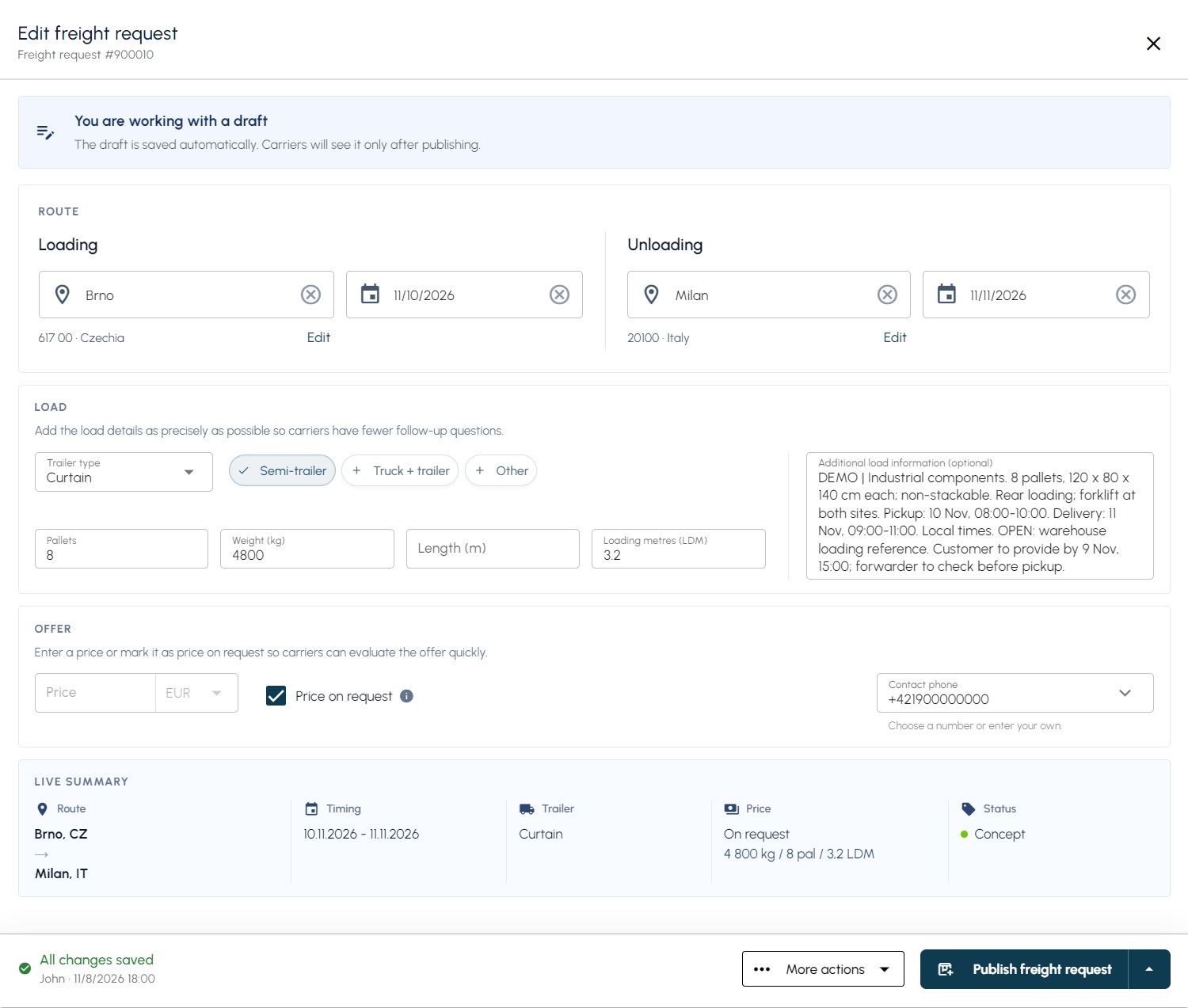
The useful part is not that every space in the draft contains something. It is that confirmed facts are accurate and an unresolved detail, such as the loading reference, remains clearly identified rather than being replaced by a guess.
Recheck material changes before confirming the price
If the customer later changes a condition that affects the job, tell every carrier whose offer may be affected. A different weight, fixed slot, loading method or equipment requirement can change both feasibility and price. Updating the working brief does not itself notify a carrier or secure agreement.
Before confirming the customer price, the forwarder should be able to explain what the carrier priced, which conditions are confirmed and what still needs to arrive before collection. That is the practical sign of a useful transport enquiry: carriers are pricing the same work, and the customer’s promise rests on a clear basis.