
The customer expects a truck tomorrow morning. The forwarder has chosen a carrier and sent the transport order. The job may look arranged, but the carrier has not confirmed the loading time and nobody owns the follow-up.
The gap often appears when the customer asks for the vehicle registration or another colleague takes over. A simple question then becomes difficult: what has the carrier actually agreed to?
Sending an order is one part of arranging the transport. The forwarding team also needs a clear response, a record of the agreed conditions and someone responsible for every open point.
A price proposal does not confirm the whole job
A carrier may quote a price while still checking vehicle availability. “We should have a truck” is different from confirming the offered route, loading time, delivery window, vehicle and price.
Before treating the transport as arranged, the forwarder should compare the carrier’s response with the customer’s requirements. If something remains open, record exactly what it is, who will follow up and when. “Waiting for the carrier” is vague. “Petra will call by 15:00 to confirm loading between 08:00 and 10:00” gives the next colleague something useful.
A sent email or delivery notification only shows that a message was sent or delivered. It does not show which conditions the carrier has accepted. Even a recorded acceptance does not guarantee that the truck will arrive as planned. The forwarder must continue checking any missing operational details.
One transport involves two separate agreements
The customer pays the forwarder. The forwarder pays the carrier. The two agreements concern the same transport, but each has its own price and conditions.
A low carrier price is only useful if the carrier can meet the promise made to the customer. An afternoon loading slot does not solve a job that must load in the morning. The same applies to extra stops, waiting conditions, special handling or a required vehicle type.
Keep the customer’s requirements connected to the carrier’s agreement, but keep their prices and private commercial information separate. This makes mismatches easier to spot before they cause a problem at the loading site.
A changed loading time can reopen the discussion
Consider this hypothetical example. A forwarder arranges 18 pallets from Brno to Rotterdam. The selected carrier agrees to load between 08:00 and 10:00. Later, the customer moves loading to 14:00.
The original agreement no longer answers the current question. The forwarder sends the new time to the carrier and records that a response is still needed. Until it arrives, the team can see that the morning slot was agreed but the afternoon slot was not.
The carrier may accept the change, request different terms or no longer have a suitable vehicle. The forwarder must resolve this with the carrier and tell the customer what can be arranged. Changing an internal record does not pass the new instruction to the carrier or confirm its agreement.
Make the next action visible
Three working habits help, whatever system the team uses:
- Record what the carrier agreed to. Keep the response with the relevant order so colleagues can see which route, times, vehicle requirements, price and conditions it covers.
- Separate acceptance from missing details. A carrier may have accepted the order but still need to provide the vehicle registration or driver information. An order with no response needs a different follow-up.
- Give every open point an owner and a time. The next colleague should know whether to call the carrier, wait for vehicle details or return to the customer.
At handover, “order sent” is therefore not enough. A useful update explains what is agreed, what has changed, what remains open and who acts next.
Where Moveniq helps
In Moveniq, the received customer order remains linked to a separate order issued to the selected carrier. The team can follow the same transport while keeping the customer price and carrier price separate.
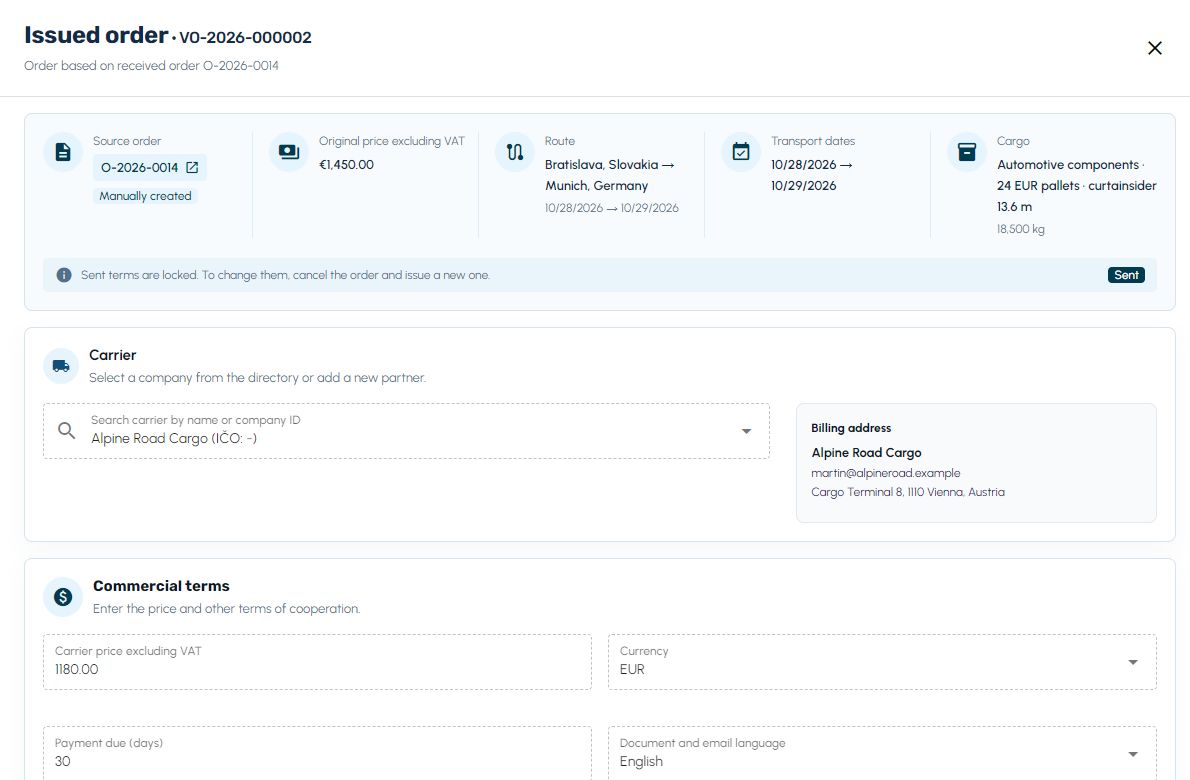
The carrier can accept or reject the issued order through a link. If the agreement happens by telephone or another channel, the forwarder can record that outside acceptance manually. This helps colleagues distinguish between an order that was merely sent and one whose acceptance has been recorded.
After accepting through the link, the carrier can supply vehicle and driver information. The forwarder reviews those details and follows up if anything needed for loading is still missing.
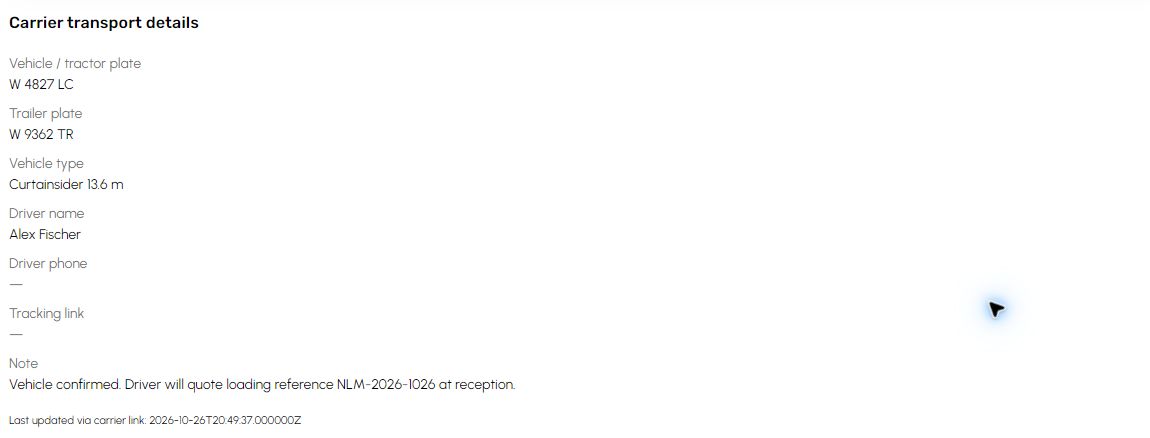
The practical benefit is a clearer shared picture. The customer order, carrier order, response and supplied transport details stay connected, while the two prices remain separate. The forwarder still checks that the records match the actual agreement.
If the customer changes a condition, the forwarder must pass it to the carrier and obtain a clear response where needed. The change is not automatically copied into the carrier’s agreement. If a carrier order is cancelled in Moveniq, the carrier is not notified automatically, so the forwarder must contact them directly.
Can the next colleague see what happens next?
Before handing over the job, ask whether another forwarder can identify the selected carrier, the conditions it accepted, the vehicle and driver information received, and every point still awaiting action.
They should also see who owns the next call and when it must happen. That helps the team continue the work without guessing. Everyone should be able to see the current agreement and what needs to happen next.