
A customer offers a new transport for tomorrow. The vehicle plan shows that one lorry should finish its current trip in the morning. It is tempting to confirm the new job before someone else takes it.
But finishing one trip does not mean the vehicle is ready at the next collection point. It may still need to unload, travel empty to the pickup, change trailers or wait for its driver. Another confirmed job may also limit how long the vehicle can remain on the new transport.
Capacity planning therefore starts with a practical question: where and when will the right vehicle, trailer and driver actually be ready?
Planned release is not confirmed availability
A planned unloading time is an expectation, not proof that the lorry will leave the site at that moment. The dispatcher needs to separate confirmed work from a provisional plan and an expected release time.
First check where the current trip should finish and how long unloading is expected to take. Then include the empty movement to the next pickup and a sensible buffer. If any part is uncertain, do not present the earliest possible time as a firm commitment.
An open-ended trip or missing finish time does not mean that the vehicle is free. It means the dispatcher needs more information before offering it for another transport.
Calculate when the vehicle could reach the next pickup
Consider this hypothetical example. A lorry is planned to unload in Linz at 09:00 on Thursday. The company allows 60 minutes for unloading. The next pickup requires 70 kilometres of empty repositioning, estimated at 90 minutes using the company’s route assumptions. The dispatcher also allows a 30-minute buffer.
The earliest planned pickup is therefore 12:00: 09:00 plus one hour for unloading, 90 minutes for repositioning and 30 minutes of buffer. These are illustrative assumptions, not standard journey times or a guarantee that the vehicle will be ready.
If unloading starts an hour late at 10:00 and still takes an hour, the vehicle is not released until 11:00. Keeping the same repositioning estimate and buffer moves the earliest planned pickup to 13:00. The dispatcher should not confirm an 11:00 collection slot on the basis of the original plan. They need to agree a suitable window with the customer or find another vehicle that genuinely fits.
This check also makes empty kilometres visible. A nearby-looking job may require a long repositioning movement from the vehicle’s actual finishing point. That movement uses time and operating capacity even though no freight is on board.
Check the complete vehicle combination
A free truck unit is not enough if the required trailer is still assigned elsewhere or does not suit the load. The dispatcher checks the vehicle combination, loading method and any equipment needed at collection or delivery.
Remaining load capacity also needs context. Spare payload does not automatically mean there is enough pallet space or usable floor area. Non-stackable goods may occupy space above which nothing else can be loaded. Capacity must be checked on each part of the route where the new freight would be on board, not only at the start of the trip.
The driver is part of the same decision. The dispatcher checks the driver’s availability and remaining driving and rest time using the company’s current records. A vehicle shown as free does not prove that its assigned driver can take another job.
Look beyond the next collection
A new load may fit the pickup but disrupt what follows. Before confirming it, check the delivery window, unloading time, onward positioning and the vehicle’s next confirmed commitment.
This is especially important for partial loads and return work. Extra freight can make good use of remaining capacity, but only if it leaves the rest of the trip workable. A short pickup detour can become a larger problem if loading takes longer than expected or the delivery moves the vehicle away from its next job.
One person should verify the release time, location, vehicle, trailer, driver and next commitment before the team confirms capacity. When the customer, site or driver provides new information, update the affected plan and reassess the promise.
Where Moveniq supports the capacity check
In Moveniq for carriers, the vehicle plan brings the carrier’s planned trips together by truck. The dispatcher can review the trip chain, assigned driver and trailer, and see overlaps that need attention.
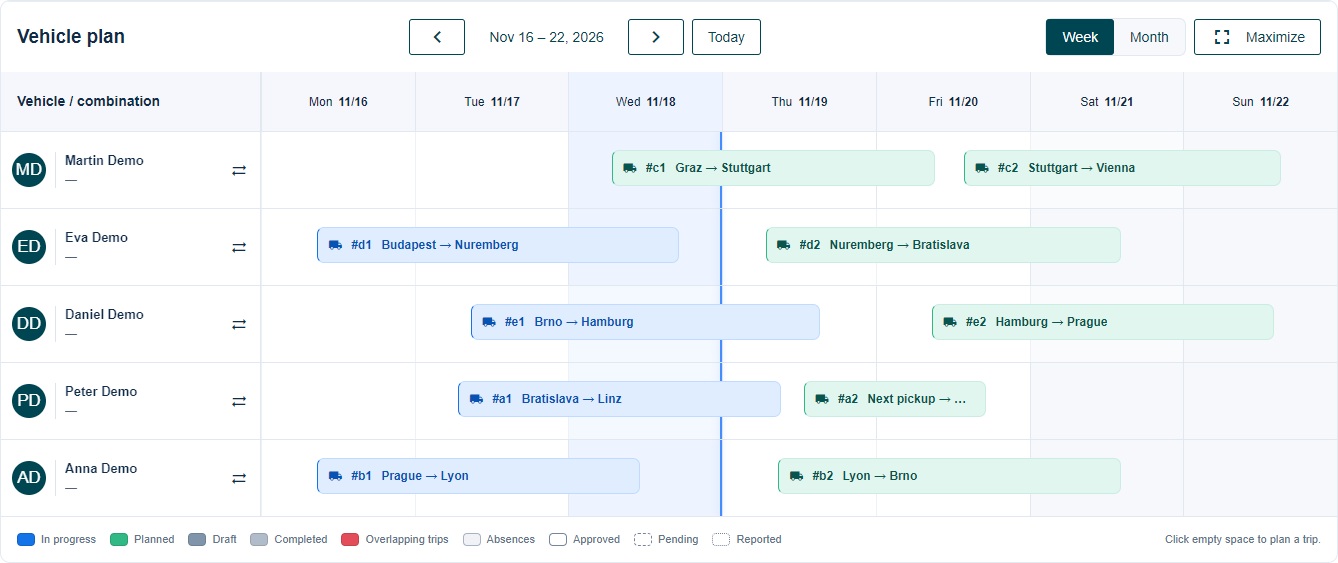
This view supports planning, but it is not real-time proof that a vehicle is available. Planned finish times can change, and missing information must be checked rather than treated as free capacity.
The saved trip also provides the route and planned stops needed to understand where the vehicle should finish. Once its expected location, time and remaining capacity are clear, Moveniq’s AI backload planner can regularly search available offers and notify the dispatcher about potentially suitable return loads or additional freight.
A suggestion is not an accepted load. The dispatcher still checks the collection and delivery windows, vehicle and equipment, remaining capacity, repositioning, next commitment and driver availability before agreeing to it.
Promise capacity you can explain
Useful capacity planning is not a count of vehicles without work beside their names. It shows which vehicle combination can reach a particular pickup, at what realistic time, with which driver and with enough capacity to complete the work without disrupting confirmed commitments.
Before accepting the next transport, the dispatcher should be able to answer three questions clearly: Where will the vehicle be? When can it realistically arrive? What capacity can the carrier safely promise? If any answer is still uncertain, the job is not ready for firm confirmation.