
The truck is due to unload abroad and return towards home. A load appears in roughly the right direction, and the price looks attractive. Taking it seems better than driving back empty.
But the price says little about the effect on the whole journey. The pickup may be far from the unloading point. The warehouse may offer only a late slot. Another confirmed job may already be waiting for the truck the next morning.
For a carrier dispatcher planning the company’s own vehicle and driver, the question is not simply, “Can we find a load?” The real question is, “Will this extra work improve the journey without disrupting what we have already agreed?”
Empty kilometres are only one part of the decision
A return load is freight carried on the way back after an earlier delivery. A part load uses spare capacity while other goods are already on board. Both can improve vehicle use, but neither is worthwhile just because it points towards home.
Compare the extra revenue with the added distance, tolls, handling and waiting. Then consider the next confirmed transport. A well-paid load can still be a poor choice if it creates a large detour or leaves the truck unable to reach its next loading.
Start with the current journey: where the vehicle is expected to finish, when unloading should end and where it needs to be next. A planned unloading time is useful for planning, but it is not proof that the truck will be free at that exact moment. The dispatcher still needs to allow for the real situation and check whether the driver and vehicle can complete the additional work.
Would the load still fit if the timing changed?
Consider this hypothetical example. A curtain-sided truck is due to unload near Munich on Thursday afternoon and return towards Bratislava. Its next confirmed loading is in Slovakia on Friday morning.
One return offer has a higher price, but the pickup is 150 kilometres away and cannot begin until Friday morning. It may look attractive when compared by price alone, but it cannot fit the confirmed Friday morning loading in Slovakia.
A second offer covers six pallets, with pickup close to the return route on Thursday. This candidate is worth reviewing. The dispatcher still needs to check the collection and delivery windows, likely waiting at both sites, the effect of the detour, the driver’s availability and the next commitment.
The second offer may fit the overall journey better even at a lower price. It is not yet a proven choice, however. If the timing or conditions do not work, returning without extra freight may be the better decision. Protecting the next confirmed job also has value.
Free pallet spaces do not tell the whole capacity story
For a part load, capacity must be checked on the section of the route where the freight would actually be on board. Space that becomes free after a later delivery is not available for an earlier pickup.
The truck may have room for six pallets but insufficient remaining weight capacity. The goods may require equipment the vehicle does not have. The planned unloading order may also leave the new pallets blocked behind another shipment.
The dispatcher therefore needs to compare the candidate with the vehicle combination, cargo already on board and remaining stops. A nearby pickup is not enough. The freight must fit the route, space, weight, equipment and driver plan at the same time.
Repeated searching is part of the workload
A suitable offer may appear after the dispatcher’s first search. Reopening the same sources throughout the day takes time, especially while the dispatcher is also following active journeys and dealing with changes.
Known contacts and manual searches remain useful. A conversation may reveal a loading delay or handling condition that a listing does not explain. The repeated search itself, however, can run in the background so that the dispatcher can focus on assessing relevant candidates.
Where Moveniq’s AI backload planner helps
The AI backload planner in Moveniq looks for additional work along an existing trip. It uses the saved route and recorded remaining capacity to find candidates that may fit the journey.
When active, the planner regularly searches available offers and can notify the dispatcher when it finds a suitable suggestion. The dispatcher does not need to repeat the same search manually throughout the day. Available sources depend on the company’s connections, while notifications depend on the user’s settings.
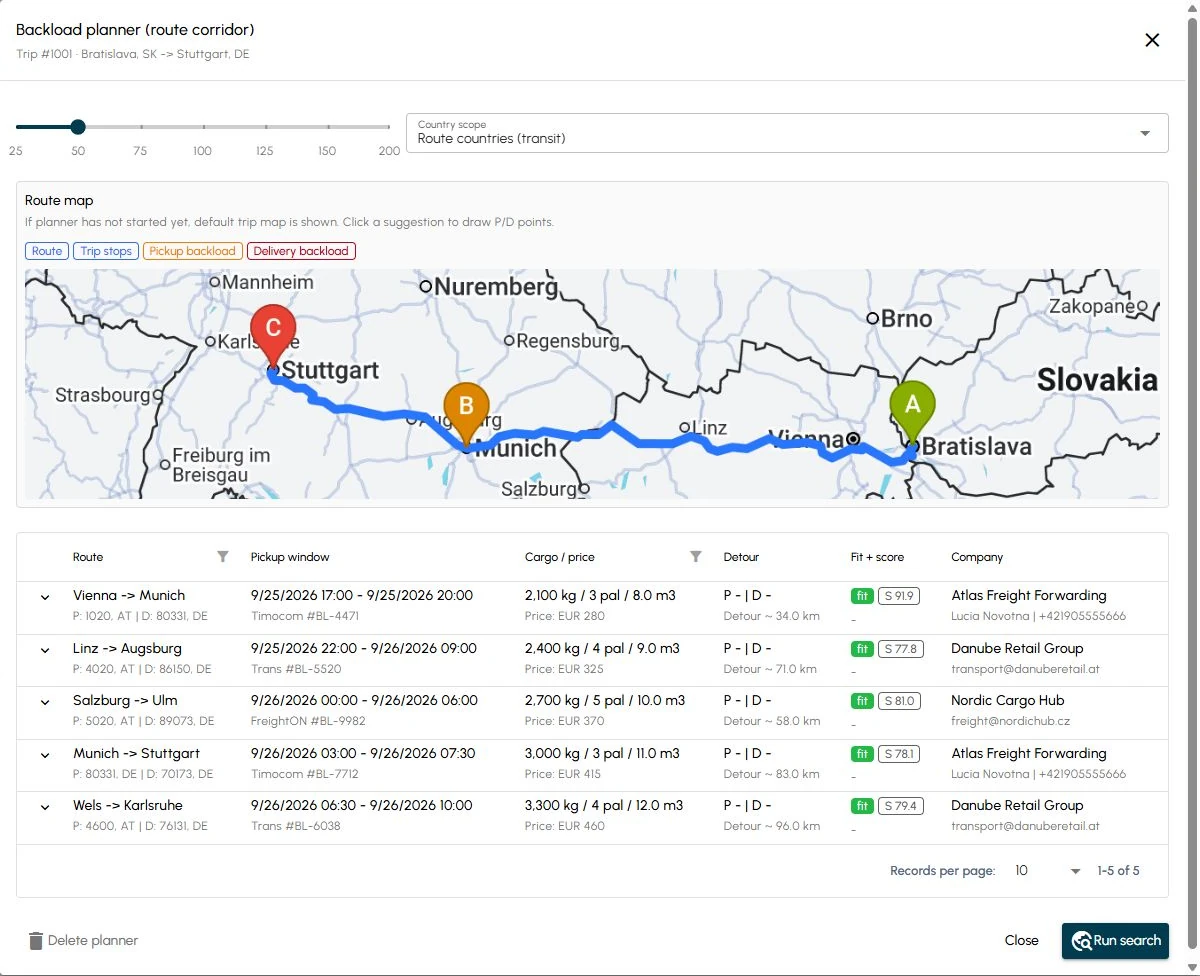
A suggestion is not an accepted load or a guarantee that the offer is still available. It gives the dispatcher an earlier opportunity to review a possible match. The dispatcher still checks the current offer, timings, equipment, remaining capacity and price with the party offering the freight.
The saved trip also needs to reflect the current plan. If the assigned vehicle, stops or existing loads change, the recorded information should be updated. Before adding extra work, the dispatcher checks its effect on every remaining part of the route and on the next confirmed transport.
Judge the whole journey, not one attractive offer
Before accepting extra freight, the dispatcher should be able to explain where it fits, how much driving and waiting it adds, what capacity it uses and why the next confirmed job remains workable.
A good return load or part load makes useful use of the truck without creating a bigger problem later. The aim is not to fill every available space at any cost. It is to choose extra work that makes sense for the whole journey.