
The driver calls from the loading site: the lorry is still waiting and loading may be delayed by two hours. The customer wants a new delivery time. Another confirmed job is waiting for the same vehicle tomorrow.
The dispatcher needs to respond, but a rough delay estimate is not enough to make a new promise. First, they must establish what is happening now. Then they can check the effect on the current delivery and the vehicle’s next commitment.
This is logistics exception management in practical terms: dealing with a change that puts the transport plan at risk.
Confirm what is known now
A reported two-hour delay is not the same as a confirmed departure time. The driver may have been told that loading will start in two hours, that it will finish in two hours or simply that the warehouse is running late.
The dispatcher should confirm when the last update was received, whether the vehicle is at the correct loading point and whether loading has started. If it has not, ask what the site has actually said and when the next update will be available.
The answer may still be uncertain. “The warehouse expects to start at 14:00” is useful, but it does not prove that the lorry will be loaded and ready to leave at 14:00. The dispatcher needs a realistic departure estimate that allows for loading, paperwork and any other work still required at the site.
Check the current delivery before promising a new time
The next question is whether the expected departure still fits the planned unloading. A two-hour delay may cause no serious problem when the delivery window has enough buffer. The same delay can threaten the whole plan when the vehicle must reach a fixed unloading slot.
Check the planned route, likely travel time and any known conditions that could affect arrival. Also confirm whether the unloading site can accept the vehicle later. An estimated arrival is only a planning figure until the relevant customer or site agrees to a changed slot.
The dispatcher should explain the current facts clearly: loading has not started, departure is estimated, and the later unloading time still needs confirmation. This is more useful than presenting an uncertain time as settled.
Follow the effect into the next confirmed job
The delay may continue beyond the current delivery. The same lorry, trailer or driver may already be assigned to another loading. The dispatcher therefore needs to check where the vehicle should finish, when it could realistically become available and how far it must travel to the next job.
The required equipment matters too. Another vehicle may be free but unsuitable for the next load. The dispatcher also checks whether the assigned driver has enough available time to complete the revised plan safely. A delay cannot be solved by assuming faster driving or less rest.
If the next job no longer looks workable, the dispatcher should examine realistic alternatives. That might mean asking whether a slot can move, assigning another suitable vehicle or telling the customer that confirmation is still pending. The right choice depends on the actual plan and the people involved.
Separate reports, estimates and confirmations
Consider this hypothetical example. At 11:30, the driver reports that loading has not started. The warehouse says it expects to begin at 13:00. The dispatcher estimates that the lorry could leave around 14:00, but this has not been confirmed.
The planned unloading slot is 17:00. After checking the route, the dispatcher expects arrival closer to 18:30. The unloading site then confirms that it can receive the lorry at 19:00. That time is now agreed for the current delivery.
The vehicle also has a confirmed loading the next morning. The dispatcher checks the remaining route, the required trailer and the driver’s availability before confirming that the next job still works. If any part remains uncertain, it stays marked as open rather than being treated as resolved.
This simple distinction prevents confusion: the driver reported the waiting; the departure time was estimated; the revised unloading slot was confirmed with the site.
Make the current plan clear to everyone involved
Once an alternative is agreed, the dispatcher communicates it to the driver and the relevant customer or site. They also record the current plan, including what changed and what still needs confirmation. A changed time in the plan is not a confirmed unloading booking. Check that the driver and customer have received the agreed instructions.
One person should own the next action. For example: “Petra will call the loading site at 13:00 and update the customer by 13:15.” This is enough to prevent two colleagues making the same call or assuming that someone else is following up.
If waiting happens regularly at the same site, the pattern deserves a separate review with the customer. The answer may be a more realistic booking time or a different working arrangement, not repeated last-minute changes.
Where Moveniq helps
In Moveniq for carriers, the saved trip brings the vehicle, driver and sequence of stops together. When the working plan changes, the dispatcher can update the trip’s planned timing and add relevant notes.
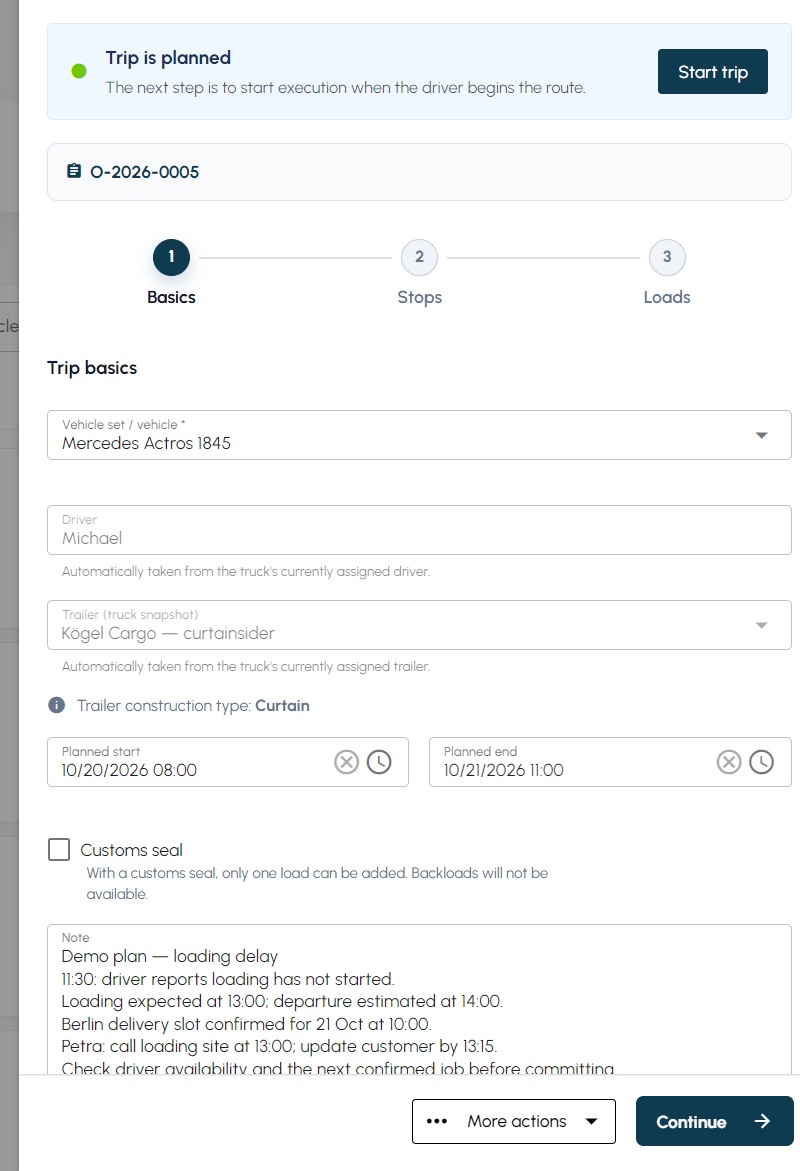
This shared view helps the team check how a loading delay affects the current delivery and the next part of the trip. The dispatcher still verifies the facts, agrees the change with the right people and keeps the recorded plan current.
The useful result is not simply a later time in the schedule. It is a plan that shows what is known, what has been agreed and what the dispatcher must check next.