
A truck finishes a delivery and heads back empty. The dispatcher has been busy all day, but there was no suitable load for the return journey. A week later, the same thing happens. Then again the following week.
For a carrier operating its own vehicles, this is worth investigating. Empty kilometres are kilometres driven without cargo, including journeys back from a delivery or repositioning to the next pickup. They consume fuel, driver time and vehicle capacity without carrying a paying load. A partially loaded vehicle is not empty; assess its unused capacity separately.
Finding a return load today might solve today's problem. But when the same empty journey keeps happening, the better question is: why does this route keep leaving the vehicle without work?
Find the routes where empty kilometres keep repeating
Start with completed trips, not just the vehicles currently on the road. Look at where deliveries finish, where the next loads begin and how far vehicles travel empty between them.
Compare similar trips over the same period. For example, in a hypothetical month with 20,000 km driven in total and 4,000 km empty, the empty-mileage share is 4,000 ÷ 20,000 × 100 = 20%. This is simply empty kilometres divided by all kilometres driven. It is not an industry benchmark.
The percentage gives you a starting point, but the individual routes tell you where to look. Perhaps several vehicles regularly finish deliveries in the same region on Friday afternoons and return without cargo. That repeated journey deserves more attention than an occasional empty trip caused by an unusual delivery.
Understand why the vehicle returns empty
An empty return does not always mean the dispatcher failed to find a load. Sometimes the available work simply does not fit the vehicle's schedule.
A late unloading can make the next pickup impossible. A suitable load might require different equipment. The driver may have another commitment, or the vehicle may need to return to the depot. Sometimes the search starts too late, leaving little time to arrange anything worthwhile.
Record the actual reason when reviewing completed trips. Do not assume that an empty calendar means no freight was available. The dispatcher may have rejected an offer because its timing, route or requirements did not work.
Change one recurring problem before changing everything
Consider this hypothetical example. A dispatcher manages a small fleet. One truck regularly delivers to the same destination, but unloading finishes too late to collect suitable return freight nearby.
Instead of repeatedly searching for distant loads after unloading, the dispatcher could discuss an earlier delivery window with the customer and begin looking for return opportunities before the truck leaves on its outward journey.
That earlier window may not be possible. And an earlier search does not guarantee a suitable load. But testing both gives the carrier a clearer idea of what is preventing the return journey from being used.
Choose one route where the problem repeats. Make a practical change, then compare the next completed trips with similar earlier journeys. Avoid changing several things at once, or it becomes difficult to understand what helped.
Check whether the change actually improves the trip
A return load may require an additional 80 km to reach the pickup point, several hours of waiting and a longer journey home. Even if the vehicle carries cargo for more of the journey, the extra distance and costs might outweigh the benefit.
Compare actual empty distance, total kilometres, waiting time and operating costs. Consider the revenue from the additional load and whether accepting it affected the vehicle's next job.
Also compare the original plan with what actually happened. A return load that looked suitable when planned may have become impractical after a delayed unloading.
The goal is not simply to improve an empty-mileage percentage. It is to make better use of the vehicle without creating a more expensive or less reliable trip.
Give dispatchers more time to find suitable return loads
In Moveniq, carriers can manage their vehicles and planned trips in one place. Its AI-assisted backload planner searches for potential freight offers along a saved trip. The planner can search repeatedly and notify the dispatcher when it finds potentially suitable opportunities.
The dispatcher still decides whether an offer makes sense. Pickup times, vehicle capacity, cargo requirements, extra distance, driver availability and the next planned job all need checking before accepting additional work.
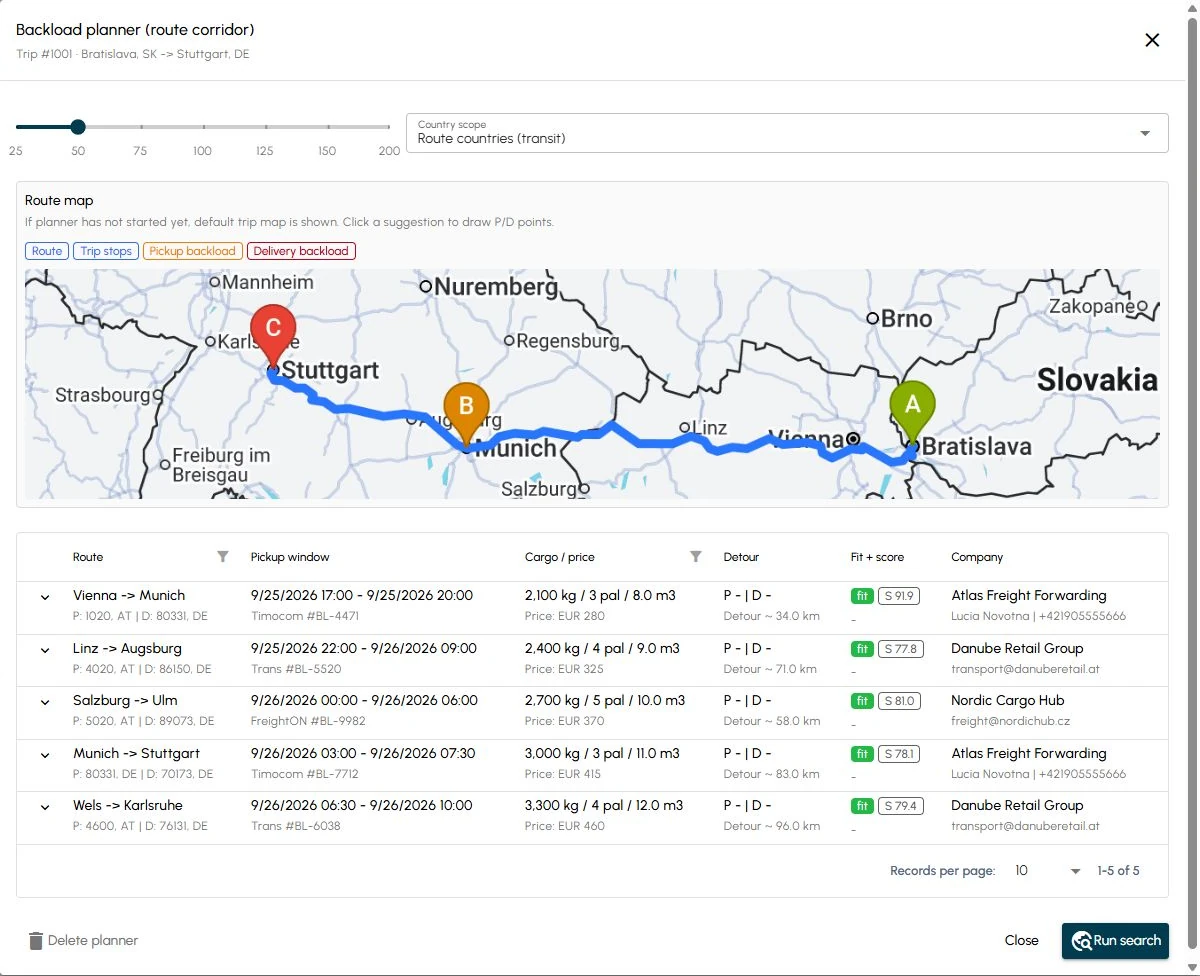
This helps with one important part of the problem: finding possible return loads earlier and with less repeated manual searching. It does not replace the carrier's own review of completed trips or explain automatically why a particular route keeps producing empty kilometres.
Make reviewing repeated empty journeys a habit
You do not need a complicated reporting process. Set aside time each month to review the routes that repeatedly produce empty journeys. Look at the reasons recorded by dispatchers and choose one practical change worth testing.
Reducing empty mileage is rarely about finding one perfect return load. It starts with recognising the journeys that keep going wrong, understanding why and making small changes that work in everyday fleet operations.