
Imagine a freight forwarder arranging transport for eight pallets from Brno to Munich. The customer requests collection on Thursday between 09:00 and 11:00, delivery on Friday before 12:00 and a vehicle suitable for side loading. A carrier offers to handle the transport for €900.
Before the forwarder commits to the carrier, the customer sends an update. The goods will not be ready in the morning. Collection must now take place between 14:00 and 16:00 on Thursday.
It sounds like a small change, but the carrier's original offer was based on different collection times. The forwarder cannot assume that the carrier can still meet the delivery deadline or provide the transport at the same price.
Many freight forwarding errors begin with situations like this, particularly when several shipments are being arranged at the same time.
Check what has changed in the customer's request
When a customer sends revised instructions, the forwarder should first compare them with the transport details already recorded. This helps establish which requirements have changed and which still apply.
In our example, the collection window has changed, but the delivery deadline, number of pallets and side-loading requirement remain the same. All these conditions still need to be met.
Simply forwarding a message saying that collection has moved to the afternoon leaves room for misunderstanding. The carrier needs enough information to assess the revised job, including the requirements that have not changed.
Confirm the revised conditions with the carrier
The later collection may still work for the carrier. However, it could affect other jobs, vehicle availability or the time available to reach the delivery location.
The forwarder should ask whether the carrier can collect between 14:00 and 16:00 on Thursday, deliver before noon on Friday and still provide a suitable vehicle for side loading. The forwarder should also confirm whether the original price of €900 still applies.
If the carrier proposes a different price, the forwarder needs to review the commercial arrangements separately. The amount the customer pays the forwarder and the amount the forwarder pays the carrier are two different prices. A change to one does not automatically change the other.
Distinguish between sending a change and receiving confirmation
Sending revised instructions does not mean that the carrier has accepted them. Even a reply such as "I'll check with our dispatcher" leaves the arrangement unresolved.
The forwarder can acknowledge the customer's revised request while explaining that carrier availability is being checked. Transport should not be presented as fully arranged until the carrier confirms the required conditions.
If the original carrier cannot meet them, the forwarder can look for another carrier or ask the customer whether an alternative collection or delivery time would be acceptable.
Keep the conversation and transport details together
When transport details are spread across emails, messages and separate records, it becomes harder to remember which conditions the carrier has actually confirmed. This is especially problematic when several colleagues work on the same shipment or someone takes over during an absence.
In Moveniq's TMS for freight forwarders, the forwarder can review the conversation with the carrier alongside the route, transport dates, price and agreement status. Keeping this information together makes it easier to check what the carrier has said, identify outstanding questions and update the transport details once the revised conditions have been confirmed.
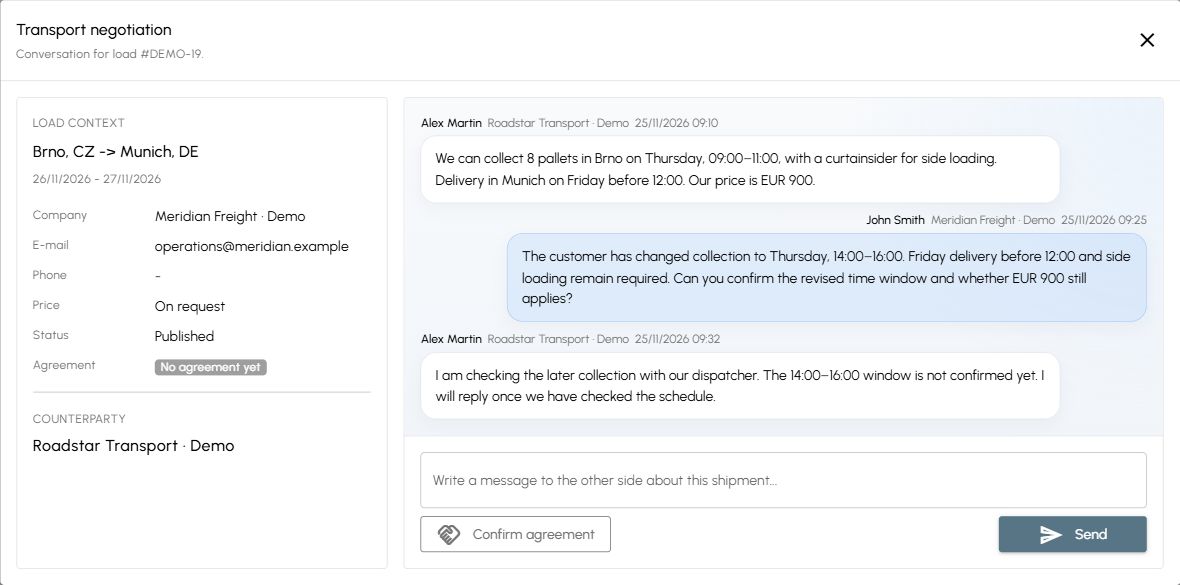
A colleague taking over the shipment can review the conversation and see why the revised collection time is still awaiting confirmation rather than relying solely on the original offer.
Make sure the transport order reflects the latest agreement
Once the carrier confirms the revised conditions, the forwarder should update the transport record and check that the carrier's transport order, when prepared, reflects the latest agreed requirements.
In our example, an order containing the original morning collection window could send the vehicle to the loading location before the goods are ready. The mistake could result in unnecessary waiting, additional costs or disruption to the carrier's other jobs.
Customer instructions will inevitably change from time to time. The important thing is to confirm both the revised requirements and those that remain unchanged before making a new commitment to the customer.