
Freight forwarders often repeat work that has already been done. A customer sends a transport request, the forwarder prepares an offer for carriers, enters the details on several freight exchanges and answers questions from interested hauliers. Meanwhile, new requests keep arriving.
Automation sounds like an obvious solution. But when a forwarding company tries to change several processes at once, the team can end up with more work. People have to learn new tools, correct mistakes and figure out which information is reliable.
The better approach is to start with one repetitive task, see whether automation helps and expand from there.
1. Find the task that takes time every day
Not every task is worth automating. Some require experience, negotiation or a decision that depends on the situation. Others involve copying information that has already been checked into another system.
Look at a normal working week and ask four questions:
- How often does the team repeat this task?
- How much time does it take, including checking and corrections?
- Does someone enter the same information more than once?
- What happens if a detail is entered incorrectly?
Consider a hypothetical forwarding team arranging a load from Brno to Munich. The customer has confirmed the transport requirements, and the forwarder needs to find a suitable carrier.
The forwarder prepares an offer and manually publishes it on three freight exchanges. Each exchange requires similar information: loading and unloading locations, dates, cargo details and vehicle requirements.
The team already has the information. The repeated work is entering and checking it across several destinations.
2. Agree on the process before introducing a tool
Automation cannot fix unclear information. If two colleagues work from different versions of a transport request, entering the details faster will not solve the problem.
Before testing anything, agree where the checked information comes from and who is responsible for it.
Suppose the customer changes the loading window after the offer has been published. Someone must update the working information, tell affected carriers where necessary and check that the published offers are still correct.
Or imagine that the customer has not specified the equipment required for loading. The forwarder should clarify that requirement before publishing the offer rather than sending incomplete information to several exchanges.
These situations need a clear owner. The team should know who checks an offer before external publication and who handles changes afterwards. A tool can reduce repeated typing, but responsibility stays with the people arranging the transport.
3. Test one workflow with real work
Choose one familiar route or customer group rather than changing how the entire forwarding department works.
First, record how the team handles a small, representative sample of offers manually. Include the time spent preparing, checking, publishing and correcting them. Otherwise, a faster publishing step might look successful even if it creates extra work later.
Then test the new workflow with comparable offers. One colleague should lead the trial, with a second colleague trained to cover absences. Keep the previous method available for situations the new process cannot handle.
Compare the total work involved, not just the number of clicks. Did the team spend less time repeating information? Were there more corrections? Did everyone know who was responsible when something changed?
4. Reduce repeated freight-exchange publishing
Publishing freight offers is one practical area where forwarding teams can begin.
For example, Moveniq for freight forwarders lets a forwarder reuse one checked freight offer across several supported exchanges without entering all the details again. The forwarder selects the destinations and checks the relevant information in the publishing workflow. Supported services require the appropriate accounts and setup, so the team should test its actual exchanges before relying on the process.
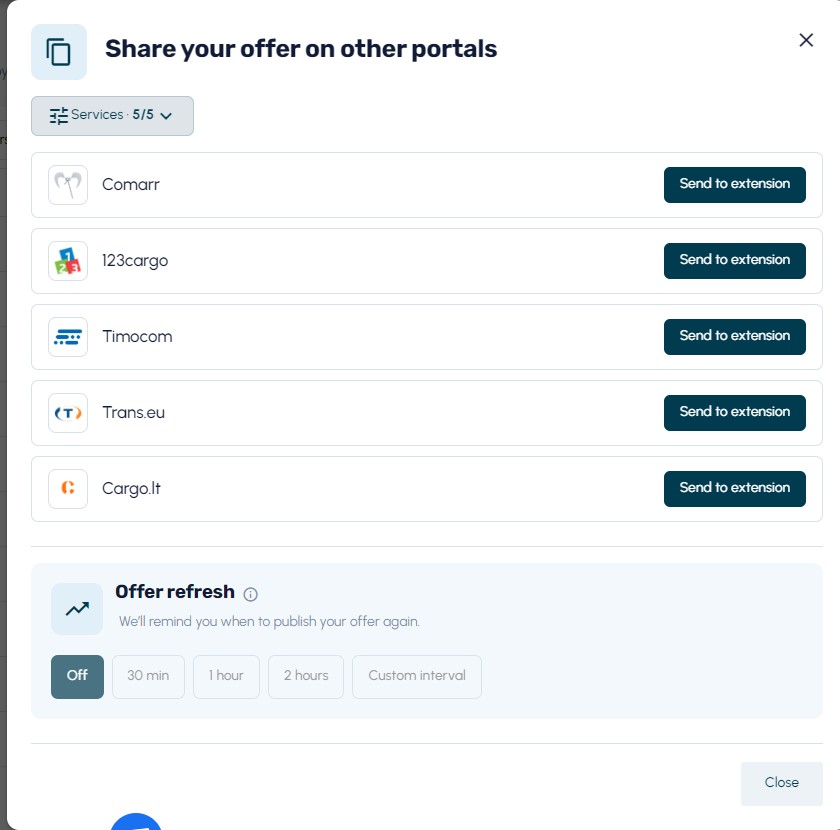
The important distinction is that reusing an offer does not remove the need to make decisions. The forwarder still chooses where to advertise the load, based on where suitable carriers are likely to be found. Publishing to every available exchange is not automatically the best choice.
5. Expand only when the first change works
At the end of the trial, review the results with the people doing the work. If total repetitive work has fallen without more corrections or confusion about responsibility, the team has a good reason to extend the process to other routes or customers.
If the trial has created new problems, resolve those before expanding. Sometimes that means improving the information received from customers rather than adding more automation.
Freight forwarding automation does not have to begin with a complete change of software or a complicated AI project. Start with work your team repeats every day, keep the checks that matter and measure the whole process. Once that works reliably, move on to the next task.