
“Has it loaded? Is it on the road? Has it arrived?” These are questions that a dispatcher at a transport company may answer several times a day, sometimes for the same customer and the same transport.
Each time, the dispatcher needs to check the current progress of the trip and pass that information back to the customer. With several vehicles on the road, these requests can take up a considerable part of the working day.
Most customers do not need to know every detail of a trip. They simply want to understand where their goods are in the transport process, what has already happened and when they can expect delivery.
Why customers need better freight visibility
Knowing the status of a transport helps customers organise their own work. A warehouse may need to prepare staff for unloading, while a manufacturer may be waiting for materials needed in production.
When customers cannot check the transport status themselves, they have little choice but to contact the transport company. Even when everything is going according to plan, the dispatcher still needs to respond.
Giving customers access to the relevant trip information allows them to check routine updates independently. The dispatcher can then spend more time planning vehicles, coordinating drivers and dealing with situations that actually require attention.
What transport status should tell the customer
A useful transport status must distinguish between what is planned and what has already happened. A scheduled pickup does not mean that the goods have been loaded. Similarly, a planned delivery time does not confirm that the vehicle has arrived.
Consider a hypothetical transport from Brno to Lyon. The vehicle is loaded, and its departure is recorded at 09:50 on 25 November. Delivery is planned for 14:00 on 26 November.
The customer can see that the transport is in progress and that the vehicle has left the pickup location. However, the delivery time remains part of the transport plan, not a confirmed arrival or a prediction based on current traffic conditions.
The time of the last update also helps the customer understand how recent the available information is.
Keeping transport information up to date
Sharing transport status is only useful when the underlying information is kept up to date. Transport companies should agree internally on who is responsible for recording pickup, departure, delivery and changes to the transport plan.
If a loading appointment changes or a vehicle departs later than expected, the dispatcher should make sure the updated information is reflected in the trip.
Whether updates are recorded manually or obtained through connected systems, the important thing is that customers can distinguish between planned events and recorded progress. This gives them a more reliable basis for organising their own operations.
Sharing transport status through a tracking link
With Moveniq TMS for transport companies, a dispatcher can share a tracking link for an existing trip. The customer can open the link without a Moveniq account and see how the transport is progressing, which stops have been recorded and whether delivery is still planned or has already been recorded as completed. The page also shows when the trip was last updated.
During an ongoing trip, the vehicle's recorded position may also be displayed when available, together with the time it was recorded.
Before sharing the link, the dispatcher should check that the selected trip and its visible stops are appropriate for the recipient.
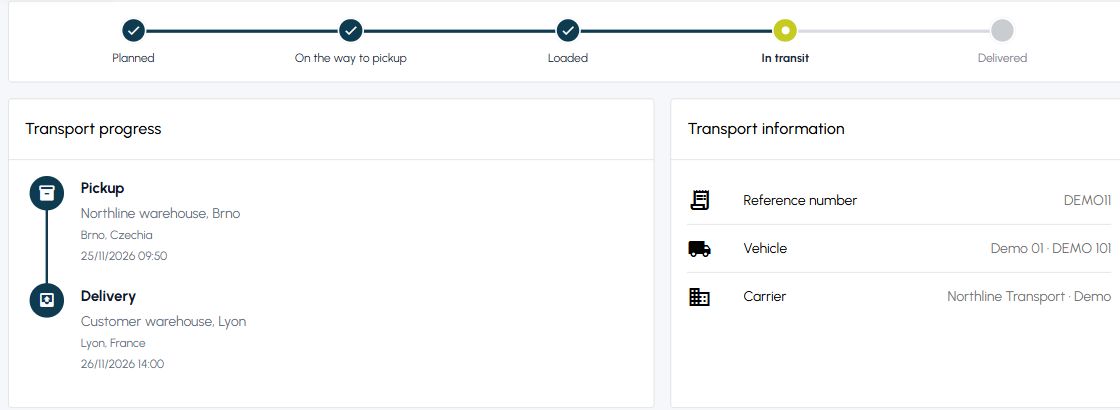
Instead of contacting the dispatcher for every routine update, the customer can return to the same link and check the latest available information throughout the transport.
When direct communication is still necessary
A tracking link does not replace communication between the transport company and its customers. If a delay affects an unloading appointment or a delivery needs to be rescheduled, the dispatcher should still contact the customer directly and agree on the next steps.
The purpose of freight visibility is not to eliminate communication. It is to reduce unnecessary requests for information that is already available and make conversations more useful when something changes.
For the customer, good transport visibility means knowing what has happened, what is planned next and how recent that information is, without having to make another phone call.