
A customer sends a transport order by email. The route is in the attached document, along with the collection date, delivery address, cargo details and agreed price. Before the freight forwarder can arrange transport, someone needs to enter that information into the system.
For one order, this might take little effort. But when similar documents arrive throughout the day, copying the same information becomes repetitive. It also creates opportunities for mistakes: a wrong postcode, an incorrect date or a missing loading instruction can cause problems later.
Automatic transport order import using AI can reduce this typing. But does it actually save work once the information has been checked?
Email can remain the way customers send orders in both cases. The choice is whether the forwarder enters the details manually or uses AI to prepare them for review.
When manual order entry makes sense
Not every transport order needs AI. If a forwarder receives only a few short requests, entering them manually may be the simplest option. The same applies to unusual orders where the details need discussion before anything can be recorded.
Manual entry also gives the operator direct control over what goes into the system. However, that does not automatically make it more accurate. A person can overlook a note or copy a number incorrectly, especially when processing several similar documents.
The important question is how much work the operator repeats and how much judgement each order requires.
When automatic transport order import becomes useful
AI becomes more useful when customers regularly send documents containing similar information: addresses, dates, cargo descriptions, quantities and agreed transport prices.
Instead of copying these details individually, the forwarder can use AI to prepare an order from the supplied document and then review the result.
That changes the work from entering every detail to checking what has been prepared. It does not remove the need to understand the customer's instructions or resolve missing information.
Manual entry versus AI: compare the whole process
Looking only at typing time gives an incomplete picture. Both approaches involve checking the customer's request, resolving unclear details and making corrections.
- Manual entry: Read the document, enter the information, check it and correct any mistakes.
- AI import: Supply the document, review the prepared information, fill in missing details and correct any mistakes.
For a simple order, manual entry may be just as convenient. For repeated, structured documents, AI may remove enough transcription work to make reviewing faster than entering everything again.
The useful comparison is therefore total time spent preparing a reliable order, not an assumed number of minutes saved by AI.
Example: an instruction outside the transport document
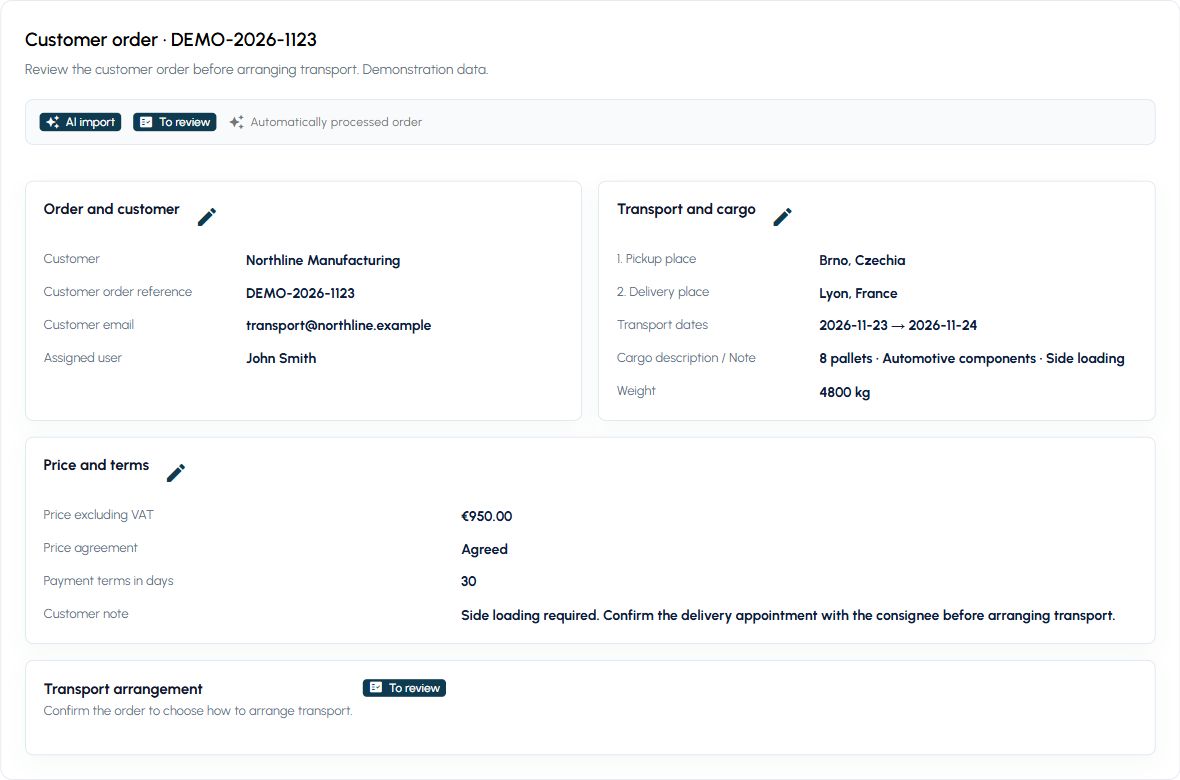
Consider a hypothetical order from a customer requesting transport of eight pallets weighing 4,800 kg from Brno to Lyon. Collection is scheduled for 23 November 2026 and delivery for 24 November 2026. The transport document specifies side loading.
In the accompanying email, the customer adds another instruction: the delivery appointment must be confirmed with the consignee.
With manual entry, the forwarder reads the document and email, enters the transport details and records the additional instruction.
With AI import, the document can provide the information needed to prepare the order. But if the email instruction was not supplied to the importer, the forwarder must still read it and carry it over.
Neither approach confirms the delivery appointment automatically. The forwarder must arrange that confirmation with the consignee.
There is also a difference between extracting a customer price and agreeing transport terms. The customer's agreed price belongs to the customer order. The carrier selected later receives a separate transport order with its own agreed terms.
How Moveniq helps prepare customer orders
In Moveniq for freight forwarders, AI import can prepare a saved customer transport order from a supplied document. It can identify available details such as the customer, reference, collection and delivery locations, dates, cargo, quantity, weight, customer price and notes. The original source attachments remain available for checking.
The forwarder reviews the prepared order, including places, dates, cargo, price and instructions, and corrects anything missing or inaccurate before deciding what to do next.
The practical rule is simple: use manual entry when requests are few, short or require substantial individual judgement. Consider AI when repeated transcription takes up a meaningful part of the day and the prepared information can be reviewed efficiently. The aim is not to eliminate checking, but to spend less time copying information and more time making sure the transport is arranged correctly.