
Two loads look like a good match. The first finishes near the second collection point, and the distance between them seems short. But when the dispatcher checks the times, the plan falls apart. The truck cannot reach the second loading point before its collection window closes.
This is why AI route optimisation for trucks needs to consider more than distances on a map. For a carrier planning its own vehicles, the real challenge is finding work that fits together across the entire journey.
Why the shortest route is not always the best trip
Road navigation finds a way to drive between two locations. Transport planning has a wider job: deciding which loads a truck can carry, in what order, and whether the complete schedule is realistic.
A dispatcher needs to account for the truck's starting position, collection and delivery locations, loading and unloading times, and empty journeys between jobs. The vehicle's next commitment also matters. A load that looks attractive today may leave the truck too far away for tomorrow's confirmed collection.
Reducing empty kilometres is useful, but it cannot be the only goal. A slightly longer journey may be more practical if the collection times fit and the truck ends up in the right area for its next job.
Two suitable loads can still make an impossible schedule
Consider a hypothetical example. A carrier's dispatcher is planning work for a truck and finds two available loads. The first delivery is scheduled for 11:00–11:30. The second load has a collection window of 11:00–12:00.
The dispatcher estimates that driving empty from the first delivery point to the second collection point will take 45 minutes. Even if unloading finishes at 11:30 and the truck leaves immediately, it cannot arrive before 12:15. The second collection window has already closed.
Now imagine another load in the same area with a collection window of 13:00–14:00. That gives the driver more time to reposition the truck and may make the schedule workable.
These times are illustrative assumptions, not estimates for a particular real route. The dispatcher still needs to check the actual driving conditions, loading requirements, driver availability and the truck's next commitment before accepting the work.
Check capacity at every stage of the journey
Timing is only one part of the problem. A truck also needs enough capacity for every load it carries.
Suppose the dispatcher considers collecting another shipment before the first has been delivered. The available capacity must be checked at that point in the journey, while the first shipment is still on board.
Weight alone is not enough. A truck may have several thousand kilograms of spare payload but insufficient pallet space for another shipment. Loading arrangements, trailer suitability and the order of deliveries can also affect whether the work is possible.
For every proposed collection, the dispatcher needs to know what is already on the vehicle, what will be added and what must be unloaded first.
What should AI consider when planning a truck trip?
AI-assisted planning can help dispatchers search for suitable work and compare opportunities without reviewing every possibility manually.
For a new trip, the starting point is usually the available vehicle, the period when it can work and the areas where the carrier wants to operate. Candidate loads can then be assessed against the wider journey.
A practical plan should include the ordered collection and delivery stops, estimated driving time, loading and unloading time, possible waiting, empty repositioning and the vehicle's remaining capacity on each leg.
Missing information matters too. If a collection time has not been confirmed, the dispatcher should clarify it before promising the truck. An assumed loading window is not a confirmed appointment.
AI can help narrow the search and highlight possibilities, but the dispatcher still needs to establish whether the complete journey works in practice.
Planning a new trip with Moveniq
For carriers using Moveniq, the AI trip planner helps find transport opportunities when preparing a new journey.
The dispatcher selects a truck and its current trailer, chooses the search period, and specifies departure and destination locations or countries. Moveniq uses the vehicle information and search scope to look for candidate transport offers.
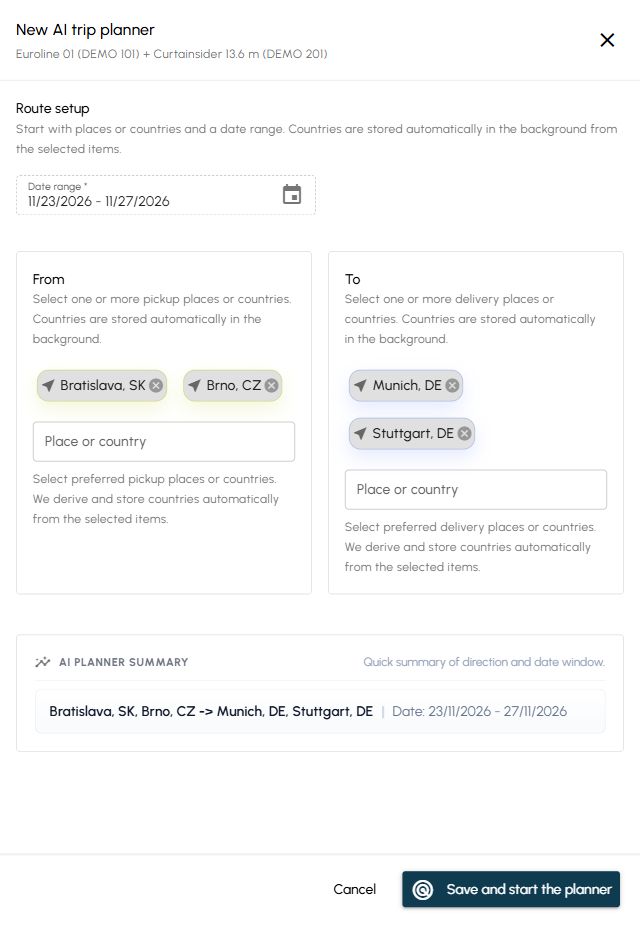
The dispatcher can review the returned offers and use a selected offer to prepare a draft trip with collection and delivery stops and its load.
Before completing the plan, the dispatcher checks the actual collection and delivery times, stop order, available capacity and other commitments.
Planning a new trip is different from finding a return load
There is also an important distinction between planning a new journey and looking for additional work on a trip that already exists.
Moveniq's AI trip planner supports the first situation: finding suitable opportunities based on the available vehicle, dates and operating areas. Its separate AI backload planner helps search for additional loads for an existing saved trip.
Both can help a carrier make better use of its vehicles, but they solve different planning problems.
Before committing to another load, the dispatcher should ask one question: does this offer fit the entire journey, from the truck's starting position through every collection and delivery to its next commitment? A good trip is not simply a collection of attractive loads. It is a sequence of work the truck can realistically complete.